|
Hunter’s habit of remaining in orbit around the
planet continued unabated. In early December, she flew to Orlando,
Florida to keynote Keeping America Beautiful’s annual conference.
She then put her teaching hat back on, as she does one week each month,
to address her MBA students at Presidio School of Management in San
Francisco.
In January, the sixth cohort of MBA students, 50
strong, began their first semester. Hunter is teaching four courses
now. She still teaches her flagship courses, Principles of
Sustainable Management, with NCS senior implementer, Paul Sheldon,
and Implementation, also co-taught with Paul. She is also
helping Dr. Russ Derrickson teach Products and Services, and Dr.
Nicola Acutt with Government, Business and Civil Society. This
means that every Presidio student has Hunter in class. If you want to
join us at Presidio, contact
George Kao.
Also in January, Hunter hosted Fast Company’s
Social Entrepreneur Awards in New York City. She then scooted back west
to present at the Energy Forum in San Francisco, then joined our
colleagues from PortionPac at the School Nutrition Association
Conference in Tucson, Arizona.
At the Rocky Mountain Sustainability Summit held on
the University of Colorado Boulder campus in February, she joined the
University’s Chancellor Bud Peterson, and Arizona State University
President Michael Crowe, as President’s of 40 universities signed the
University President’s Campus Climate Challenge pledging to make their
campuses carbon neutral. Presidio and the University of Colorado are
among the first 100 campuses to make this pledge. She shared the
plenary stage with NCS
National Leadership Summits for a Sustainable America Project
Director & Consultant Bill Becker at the keynote event, “Cutting Edge
Sustainability.” Brianna and Kate, from the NCS office, staffed the
table at the Green Products Expo held in conjunction with the Summit.
Thousands of students from universities and high schools, as well as
community members and experts in the field used the expo to learn more
about sustainability and sustainable products.
March found Hunter keynoting the Rocky
Mountain Land Use Institute’s annual meeting, and rejoining her old
friend, Governor Dick Lamm, to speak to his class at the University of
Denver. Then it was off to Everett, Washington, to deliver the keynote address
to over 700 people at the Built Green Environmental Conference.
Perhaps the stellar event of the winter was the
mid-March invitation for Hunter to brief the entire senior management of
Wal-Mart at their Business Sustainability Milestone Meeting on Thursday,
15 March. Despite having to invert her schedule to make it happen,
Hunter never hesitated: the chance to influence the world’s largest
company was not an opportunity to be missed.
It is hard to over-estimate the magnitude of their
potential leverage. If Wal-Mart were a country, it would be the 20th
biggest in the world. Previously one of the most reviled companies; it
has become the poster child example of a company in profound
transformation.
Hunter was invited, in part because there is a bit
of a culture clash between the “old” Wal-Mart culture of hunters and
fisherfolk, who like to drive pick-up trucks, and who built the
company; and the “new” Wal-Mart of Ivy-league MBA’s, environmental
consultants and left coast change agents. Some Wal-Mart insiders
thought that Hunter might offer a bridge.
With NCS Operations Director, Jeff Hohensee, Hunter
flew to Bentonville, Arkansas. Professor Jon Johnson of the Walton
School of Business invited the NCS team to advise the interdisciplinary
group at the University of Arkansas, charged with creating a Center for
Sustainability. Hunter also met with University of Arkansas students
and joined an evening panel with Jib Ellison of Blu Skye consultants,
facilitator of Wal-Mart’s sustainability efforts, and her old friend
Adam Werbach of Act Now Productions. Adam, the youngest-ever elected
President of Sierra Club, has been hired to teach Wal-Mart managers
about sustainability. He figures that by the time he has finished, he
and his team will have spoken with 1% of the U.S. workforce. Talk about
leverage. The three shared their perspectives about how Wal-Mart could
use its market power to drive change.
The next morning, the group joined Wal-Mart’s
senior management, their major suppliers and non-profit partners in the
huge auditorium at the Home Office. Hunter followed her old friend, Jim
Woolsey, ex-head of the CIA to the podium. Jim warned the standing-room
audience of the perils to the country of failing to get off imported
oil. He spoke of the national security reasons to shift the economy to
renewable energy and energy efficiency, drawing on the work presented in the 1981 book,
Brittle Power.
Hunter was equally challenging, raising the social
issues that Wal-Mart critics have used to hammer the company. She
asked, “What would a truly sustainable Wal-Mart business model be?” She
continued, “Fair enough, it’s great that Wal-Mart is putting solar
panels up and selling organic underwear. But if you roam the planet
exploiting people in developing countries and communities in America so
that people like me can throw away more junk . . . this is not
sustainable.”
She then posed what the company might do
differently: work with communities to create business ecologies, in
which Wal-Mart partners with local sustainable businesses who might
co-locate and piggyback off Wal-Mart’s strengths. Urban Wal-Marts could
partner with local community groups and suppliers to implement
sustainability programs. Or the company could bring sustainability to
communities in developing countries. . . .
Hunter described the business case for behaving
more sustainably, and how the elements of NCS’ Integrated Bottom Line
can reduce cost, increase profits, reduce risk, preserve a company’s
franchise to operate, increase labor productivity, attract and retain
the best talent, reduce the cost of distrust, differentiate a brand and
drive innovation.
After she spoke, a senior Vice President came up
and thanked her for bringing the missing conversation into the room.
Is the Wal-Mart commitment authentic; is it
cherry-picking or just very well presented PR? Hunter and Jeff sat
beside Lee Scott for an entire morning, listening in some amazement to a
litany of speeches that could have been presented by Hunter’s students
at Presidio or by such business sustainability leaders as Ray Anderson
(who has been advising Wal-Mart for some time). At one point, as Scott
was speaking, he turned to his head of sustainability and asked where
the company was “on getting that chemical out of the plastics in
children’s toys....? Are we on top of that?”
The executive jumped up and said “We are now!!!”
The air filled with the whir of fingers on
"Crackberries," as the roughly 2/3rds of the room of a thousand people who
were major Wal-Mart suppliers scurried to text home offices that they
were going have to get phthalates out of plastic. Over a decade ago,
Dr. Theo Colburn fell on her sword, sacrificing her career to expose the
dangers of endocrine disruptors. Now a throwaway line from the CEO of
the world’s largest company might just get the job started.
As senior executives unfurled chart after chart
demonstrating why sustainability is just good business, charts that
looked eerily like the sorts that environmentalists have used for
decades to argue that this is not an issue of environment versus
business, Jeff turned to Hunter and said “We really are on a
different planet.”
Then the Wal-Mart marketing folk got up to say how
they have studied the Wal-Mart demographic (and you’ve got to believe
that they have. . .) There turns out, they reported, to be a very
significant correlation especially between their female shoppers, the
dominant demographic, and a desire for sustainability. Lee Scott stood
up to state that: “Working class people should not have to choose
between affordability and sustainability.” Wal-Mart will re-brand
itself as “affordable sustainability.”
As these marketers spoke, one of the company’s
change-agents knelt beside Hunter. Did she realize, he asked, just how
historic a moment this was. . . .? In all prior meetings, he explained,
the marketers have said of Wal-Mart’s sustainability commitment, “Yeah,
whatever. . .”
This was apparently the first of the senior
management meetings at which that whole segment of the company had
gotten on board. With them acknowledging the business case for
sustainability, the entire company was committed.
The meeting over, Hunter raced for a plane to
arrive in the waning moments of a Presidio open house that evening in
San Francisco. When Presidio’s Director of Marketing, Rebecca Bell,
asked her where she’d spent the day, Hunter told these stories,
concluding with what a profoundly disorienting experience it was to be
at such a meeting.
Again, it is hard to overstate the magnitude of
this transformation. Wal-Mart has moved the debate from whether there
is a business case for sustainability to how to integrate the social
issues, and just how fast can you implement everything that Natural
Capitalism teaches. As Wal-Mart begins to send their environmental
scorecard out to their 90,000 suppliers, the entire field of
sustainability had better grab a whole new gear. Gives a whole new
twist to Pogo’s observation that “We have met the enemy and he is us.”
And, Hunter added, this is an even stronger reason
to enroll in Presidio. “As I was leaving, a senior Vice President
approached me and asked whether Wal-Mart could hire Presidio graduates.”
Wal-Mart certainly has a lot of work to do.
Hunter’s questions to the audience in Bentonville remain unanswered.
Hunter and Jeff will begin discussions soon with Wal-Mart executives
charged with sorting out the company’s relationships with communities
around the world. It was clear from being at the Home Office that the
corporate commitment to make compact fluorescent lights affordable to
all customers could start at home: employee productivity at the “Cube
Farm,” the company’s windowless, warehouse-sized concrete box of a World
Headquarters, would soar if they day lighted their roof, as they once
did in their first experimental green building. (Retail sales went up
40% in the day lit sections and all the employees wanted to work there.)
But the lever has begun to pry: As Hunter and Jeff
returned to Colorado, they were contacted by a Wal-Mart supplier asking
whether NCS could help them design a sustainability program that would
not only meet Wal-Mart’s scorecard, but position this company as a
leader in their industry. Jeff has already been to Chicago this week
to meet with the company.
Hunter has long stated that a commitment to
sustainability enhances every aspect of shareholder value, and that the
companies that get it right will be first to the future—the billionaires
of tomorrow. Every one of Wal-Mart’s suppliers now faces the challenge
of proving that they are green enough to get shelf space.
Does that make Bentonville now the epicenter of the
worldwide sustainability movement? Is Wal-Mart The Hundredth Monkey?
In the end, that will depend on each of you.
Genuine sustainability means a lot more than some profitable waste
reductions and cheap recyclables. Will each one of us insist that
companies take the actions to become socially just and environmentally
responsible business models? And as the companies adopt such practices,
can we move at a pace fast enough to match the enterprise of tomorrow?
We’re
gonna give it a go. Join us in bringing the sustainability
revolution to scale.
The NCS Climate Protection Manual for Cities,
released March, 2007 is available for free at our website:
www.climatemanual.org.
Leaders from state and local governments are
filling the leadership void left by the Federal Government. Over 400
communities across the United States have pledged to reduce their
greenhouse gas (GHG) emissions. Many cities, however, do not know
where to begin. Until now, no comprehensive plan has existed that shows
cities exactly how to deliver the energy savings and greenhouse gas
reductions needed to relieve the threat of climate change. Now, Natural Capitalism
Solutions is proud to release this manual.
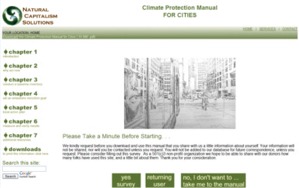
Commissioned by the National Leadership Summit for
Sustainable America on Climate, the Manual provides local governments
with the expertise they need to curb their city’s greenhouse gas
emissions, while strengthening the local economy, enhancing the local
security and improving the quality of the city.
The NCS Climate Protection Manual offers cities
three basic tools:
-
A comprehensive action plan for cities
-
Best practices and resources
-
Case studies and model ordinances
The Climate Protection Manual for Cities arms
mayors with the ammunition they need to build political support for
aggressive climate protection. It gives mayors and their staff such
chapters as the Drivers of Change, the Business Case for Climate
Protection and Risk Mitigation. It presents a process that includes
conducting a baseline inventory. It provides a simple, effective,
standardized means any community can use to develop a Local Action Plan
to reduce the emissions from both government operations and the
community as a whole. The manual offers resources, tools, programs and
case studies that describe how cities and communities can work together
to reduce their emissions, reduce the impact of their current emissions
and mitigate the impacts by global warming that are already inevitable.
Review Process
An initial draft of the manual was released to
dozens of mayors for peer review at the Sundance Climate Summit. It was
also offered for comments to municipal staff and climate experts in
November 2006. The responses and recommendations were incorporated
December through March 2006.
This manual is for you. Whether you are a public
official or citizen, we encourage you to download and share it with as
many people as possible.
The Natural Capitalism team is available to provide
an array of services, accommodating any group size. We offer training
sessions for mayors, city planners, local government leaders,
sustainability coordinators and environmental departments. NCS staff
can deliver workshops and consultation services. Sessions emphasize an
interactive dialogue, as well as lecture-delivered content. NCS staff
is recognized for its inspirational and effective ability to deliver
climate protection expertise. Companies, communities and countries work
with us over short or extended periods to implement climate protection
programs. Between our core staff and ever-expanding network of
associates, Natural Capitalism brings decades of experience to the
table.
Contact
Natural
Capitalism Solutions today about implementing the Climate Protection
Manual in your city.
The companion manual, Climate Protection Manual for
Businesses is in the works. A how-to manual for small to medium sized
businesses will be available at our website by next winter. Watch for
details!
Thank you to our donors for making this manual
possible.
NCS’ Climate Protection Manual for Cities was made
possible through the support of our gracious colleagues, Audrey and Rick
Levine, at Paradigm Nouveau Enterprises, (PNE) and as well as many other
donors.
NCS Projects: Implementing Natural Capitalism
U.S. Army’s Fort Carson Mountain Post
Christopher Juniper continues his work with Fort
Carson Mountain Post, leading its sustainability implementation team.
This year’s challenge is to develop a 20-year (to 2027) sustainable
transportation plan for the Post (20,000 people growing to about 30,000
in coming years). Christopher is leading a collaborative planning
effort that includes the regional council of governments, City of
Colorado Springs, Mountain Metro transit and the office of U.S. Senator
Ken Salazar. There appear to be no templates for such a plan.
Short-term goals for Fort Carson’s Sustainability Transportation team
include reducing single-occupancy vehicle use and reducing greenhouse
gases. The final plan is projected to be completed towards the end of
2007.
 NCS friend, Olivia d’O Castillo Executive Director
of the
Asia Pacific Roundtable for Sustainable Consumption and Production
invited Christopher Juniper to represent NCS at the Roundtable this
April in Hanoi, Vietnam. APRSCP, a non-profit dedicated to
sustainability progress in a rapidly growing corner of the world, hosts
the biennial “Roundtable” to bring together development practitioners
with governments and NGOs from throughout the region. This year, at the
7th APRSCP Roundtable, Christopher Juniper will present NCS’ tools for
sustainable development: LASER, the Management Helix and the Natural
Capitalism Life-cycle Analysis System (used by Clif Bar in 2006).
Also presenting at the Roundtable will be
Christopher’s daughter, Emma Juniper, a senior at Clark University who,
as a “veteran” of three Youth Stakeholder groups supporting the United
Nations Commission on Sustainable Development, will present her research
and conclusions regarding best practices for utilizing youth
stakeholders by governments and corporations. Needless to say,
Christopher is a very proud papa, and is excited to spread the wisdom of
NCS’ cost-effective sustainability tools to businesses, governments and
NGOs. For more info or to request a copy of Christopher’s paper for the
Roundtable, contact:
[email protected].[back
to top]
Define Sustainability: Brundtland + 20
Have you ever struggled to define just what
sustainability means?
Try it.
All of Hunter’s students do, as writing their own
definition of what sustainability means is the first exercise done in
the Principles of Sustainable Management class at Presidio.
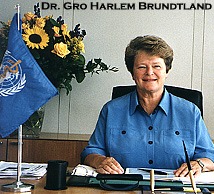
In 1983, the United Nations established the World
Commission on Environment and Development and appointed Dr. Gro Harlem
Brundtland, a former environmental minister and later the Prime Minister
of Norway, to lead it. The Commission identified the critical global
environmental and developmental issues facing the planet, and set out a
course to address them.
Over the course of three years, the Commission,
featuring experts from 21 nations, the majority from World 2 and 3
countries, sponsored over 75 studies on environment and development
issues and held public hearings. In 1987, the “Brundtland” Commission
published its report, “Our Common Future.” It set forth the Brundtland
definition of sustainable development: meeting the needs of the
present without compromising the ability of future generations to meet
their own needs. That formulation has served as the United Nations’
official definition ever since.
That was 20 years ago. This April, Hunter traveled to Capri, off the coast of Italy, as part of an international team tapped to update the classic
definition of Sustainable Development. In May, the experts’ work will
be presented to the United Nations in New York. Hunter is deeply
honored to carry her students’ work, and her 30 years of experience in
the field to help craft the next world definition.
What
is your definition of sustainability?
See
www.natcapsolutions.org/sustainability.htm, or
www.sustainabilitydictionary.com for a few
popular definitions.
[back
to top]
Who Is New to NCS!
Jeff Hohensee – Operations Director &
Natural Change co-author
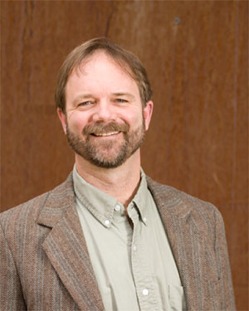 Jeff and Hunter met last year on Hunter’s trip to
Detroit to speak at a regional Bioneers event. Both used to live in Los
Angeles and work with TreePeople. They both drive trucks, like country
music and enjoy sipping good whiskey while saving the world. Jeff is a
change management expert who has worked in business, education and
sustainability for over twenty-five years. Hunter was looking for
someone to help write the sequel to Natural Capitalism who was
experienced in making things happen.
Jeff started traveling to Colorado to work with
Hunter on writing the book they are calling “Natural Change: Bringing
the Sustainability Revolution to Scale.” He got along so well with the
entire Natural Capitalism team, that when Hunter and Robbie decided to
bring someone in to take the organization to the next level of
capability, Jeff was the first person Hunter suggested. Jeff has joined
the NCS team as Operations Director. He is currently focused on new
business development. Over time, he intends to solidify the business
services and work with NCS staff to forge new relationships with
government, local communities and for- profit ventures. Look for a
revitalized business plan in the months ahead.
Jeff worked in corporate finance for Barclays
American Business Credit and Fuji Bank subsidiary Heller Financial. He
specialized in time and motion studies, department reorganizations, cash
management, financial analysis and negotiations. Leaving the private
sector to teach, he worked as a public school teacher and as an adjunct
faculty at Citrus College. Jeff served as the Program Director and
Education Director at TreePeople, where he pioneered work on education,
community building and social marketing that touched the lives of
millions of people. Jeff frequently advises on environmental
sustainability, community building and business development and has
extensive experience in curriculum development, program evaluation,
civic engagement, project management, business planning, strategic
planning, focus groups, organizational development and change
management. He is an inspiring speaker whose interviews and
presentations include print media, television, DVD movie featurette,
universities, professional associations, business, government agencies
and community groups. He has keynoted such conferences as California
Youth Service, Lake Tahoe Environmental Education Consortium annual
meeting and the U.S. EPA Community Leadership Conference. You can
contact him at
[email protected].
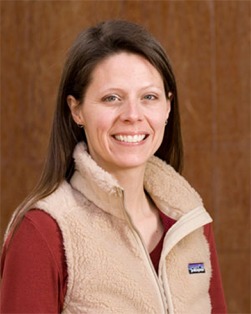
Michelle Brantley – Bookkeeper
Michelle is a freelance accountant and recently joined NCS part-time
to handle the finances. She has worked with several non-profits in
Colorado and in her home state of South Carolina, such as the
Colorado Conservation Trust, the Coastal Community Foundation of SC,
and the SC Center for Birds of Prey, as well as being on the board
of the Rocky Mountain Bird Observatory. She holds an M.B.A. from
the University of South Carolina and a B.A. in Finance from Clemson
University. She tries to spend as much time as possible outside
bird watching, rock climbing or hiking with her dogs.
[back
to top]
Join the NCS Team
Consider joining NCS as a summer intern. Information about our
internship program and how to apply can be found at
www.natcapsolutions.org/jobs.htm. Or contact
Brianna Buntje for more
information. Summer application deadlines are approaching soon!
[back
to top]
Take Action!
Take action by attending one of these sustainable
events. Read more about these and other events on the
NCS calendar.
4/18/2007 California Commonwealth Club San Francisco,
California Green Capital.
http://commonwealthclub.org/mlf/#greencapital
4/19/2008 Presidio event at which 3 lottery winners lunch
with Hunter at Liverpool Lil’s.
4/19/2007-4/22/2007 Presidio Residency in San Francisco,
California. MBA in Sustainable Business Management.
www.presidiomba.org
4/20/2007 KB Homebuilders Community Advisory Board
Meeting in San Francisco, CA.
5/12/2006 Ojai California Environmental Congress in Ojai,
California. Open to the Public.
http://www.ojaigreencoalition.com/
5/17/2007-5/22/2007 Presidio Residency in San Francisco.
MBA in Sustainable Business Management.
www.presidiomba.org
5/26/2007 Second Alberta Summit on Environmental Education
in Alberta, Canada “Trails to Sustainability.
www.abcee.org/trailstosustainability/agenda.html
6/4/2007-6/8/2007 National Leadership Summit on
Communities in Racine, Wisconsin Communities—and Climate Change, 40 top
leaders convening at Wingspread Conference Center of the Johnson
Foundation.
http://www.summits.ncat.org/
6/9/2007 Presidio 2007 Spring Graduation in San
Francisco.
www.presidiomba.org
6/13/2007 City Public Service Energy Meeting in San
Antonio, Texas. Future of Electrical Energy.
6/19/2007-6/20/2007 Chicago Climate Exchange Annual
Members Meeting in Chicago, Illinois. CCX members & special guests.
www.chicagoclimatex.com
6/21/2007 The Southwest Washington Sustainability Conference and
Trade Show in Vancouver, Washington.
6/25/2007 Goodwill Meeting in Pittsburg, Pennsylvania.
6/26/2007 Backbone Campaign Summit in Atlanta, Georgia.
6/26/2007-6/28/2007 Presidential Climate Action Plan
Racine, Wisconsin. 100-day action plan for next U.S. President.
http://www.climateactionproject.com/
7/28/2006 Earth Works Conference in Denver, Colorado.
www.earthworks2007.com
8/7/2007 Leadership America Conference in San Francisco,
California.
10/6/2007 Green Festival Washington, D.C.
www.greenfestivals.org
(D.C. specific information:
http://www.greenfestivals.org/content/view/625/280/)
11/1/2007 AME Conference in Chicago, Illinois.
Consider
Supporting Natural Capitalism Solutions.
[Click Here] to email [email protected] with questions or
more information.
[back
to top]
|